🌉 In-Water Drilling Starts & Funding Still Uncertain - HR Bridge Meeting - Feb '26
The new bridge enters in-water drilling as its first tribal agreement is signed. But $35M in contingency is already gone and new federal funding uncertainty looms. Here’s what changed, what escalated, and what it means for the 2027 construction timeline.
Hood River-White Salmon Bridge Authority
February 9, 2026 Meeting Recap
The Bridge Authority continues to aim for a fall 2027 construction start, but that timeline depends on full federal funding and meeting strict in-water work windows. One earlier delay already added $35 million in inflationary costs. Officials say missing another funding window could push the schedule another year and significantly increase costs, making grant timing one of the biggest variables in the project’s future.
🏗 Design & Engineering: Foundations, Monitoring, and Geotech
The project remains focused on structural and foundation design, with stormwater and hydraulic design continuing. Key updates:
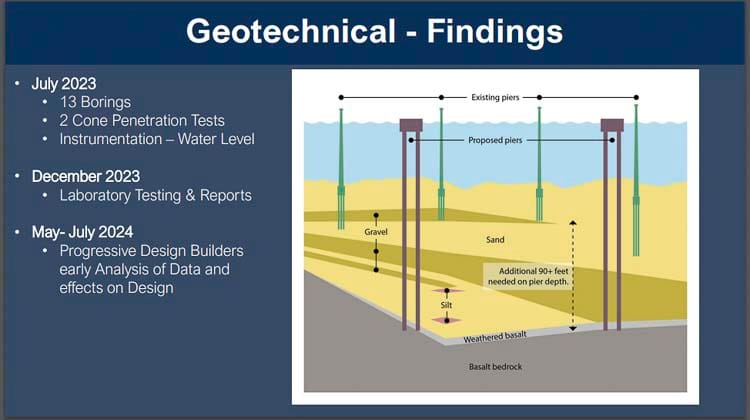
- Geotechnical borings are expected to begin shortly on the Oregon side, with barges reportedly en route (Editor's Note: as of the time of this post, these small barges are now visible on the Columbia).
- The team is negotiating access across the Treaty Fishing Access Site (TFAS), which could:
- Save roughly $100,000
- Avoid two bridge closure days
- Improve long-term working relationships during construction
- Bridge monitoring equipment is nearly fully installed, with only the tide monitor remaining. Once data connections are finalized, live monitoring dashboards will follow.
- A preliminary trestle design raised concerns:
- ~170 piles proposed across the river
- Some piles located as close as 25 feet from existing bridge foundations
The Engineering Committee is evaluating whether earlier test pile work may be needed to protect the current bridge.
💰 Budget & Contingency: A Tightening Cushion
The baseline project budget remains $1.12 billion, with roughly $132.6 million in contingency (about 11-12%).
However, commissioners noted that a one-year schedule delay, caused by missing anticipated federal grant timelines, has already consumed $35 million in contingency funds.
If additional delays push the project outside its permitted “in-water work window,” the cost impact could reach $40-60 million more.
The message from the board: keeping federal funding moving is critical to protecting ratepayers and toll projections.
🏛 Federal Funding: INFRA, BIP & Sanctuary-State Memo
The Authority is revising its INFRA grant application, structured as:
- $75 million for design
- $100 million for construction
- $8 million in Congressionally Directed Spending (CDS)
Congressionally Directed Spending (CDS), formerly known as earmarks, refers to funds set aside by Congress in federal appropriations bills for specific projects, programs, or grants requested by members. The application is moving back through FHWA review and then to the Office of the Secretary of Transportation.
Meanwhile, a new federal Office of Management and Budget memo is requiring agencies to list all funding obligations to 14 “sanctuary states,” including Oregon and Washington. While officials say this is not necessarily tied to withholding funds, $1.5 billion was recently withdrawn from four other states.
Bridge lobbyists are monitoring closely. Any slowdown or disruption in federal grant processing could affect timeline and costs. The Authority is also awaiting clarity on Bridge Investment Program (BIP) award announcements for FY2025.
📊 Project Performance Snapshot
- Kiewit’s design work is currently about 6 weeks behind schedule, largely due to geotechnical permitting delays.
- However, spending has been under budget for completed work.
- HNTB spending is also below plan, though full earned-value reporting is pending.
The board has emphasized tracking against the official baseline schedule, rather than shorter internal planning schedules.
🗂 Governance: Clerk Appointed
The board formally appointed Kelly (HNTB - Howard, Needles, Tammen & Bergendoff) as Clerk to the Board, formalizing records management responsibilities under the bylaws.
🧑🏭 Workforce Development: High School Outreach
One of the more exciting forward-looking updates:
The Authority is beginning outreach to high schools on both sides of the river to connect students with apprenticeship pathways in the construction trades. They’re coordinating with labor unions and plan to expand outreach to tribal partners as well.
Construction would begin as current students enter the workforce - creating a local pipeline for skilled jobs.
🌿 Environmental & Permitting
- Section 408 and U.S. Coast Guard bridge permit applications are about to be submitted.
- Section 408 refers to Section 14 of the Rivers and Harbors Act of 1899. If a project affects a river, levee, dam, navigation channel, or other federal water infrastructure, it may need Section 408 permission from the Corps.
- ESA (Endangered Species Act) coordination is progressing.
- CEPA review on the Washington side is expected this spring.
- A right-of-entry permit from Washington DNR for geotech work is still pending but not yet considered a schedule risk.
🔄 What Changed
- First Tribal Agreement Signed: The MOA with the Umatilla Tribe is complete (pending final FHWA signature) - the first of four required agreements.
- River Work Begins: Geotechnical barges are arriving; in-water drilling is about to start.
- Bridge Monitoring Goes Live: Movement sensors on the current bridge are nearly online.
- Governance Tightened: The board formally appointed a Clerk to strengthen compliance and record keeping.
⚠️ What Escalated
- $35M Already Burned: A schedule slip has already consumed $35 million in contingency. Missing another in-water window could add $40-60M more.
- Federal Funding Uncertainty: A new OMB memo targeting “sanctuary states” (including OR & WA) adds ambiguity around future federal transportation funding.
- State Budget Risk: Washington’s transportation budget faces pressure amid a broader deficit. The bridge isn’t singled ou, but it’s not insulated either.
- Schedule Tension: Kiewit is ~6 weeks behind internal schedule due to permitting delays, though currently under budget.
⏭ What’s Next
- INFRA Grant Moves Forward: Revised $75M design / $100M construction package heads back through federal review.
- BIP Funding Watch: Awaiting word on 2025 Bridge Investment Program awards.
- River Borings Inform Design: Foundation data will shape final structural decisions.
- Workforce Pipeline: Outreach to local high schools begins for future trade apprenticeships.
- Next Meeting: February 23, 2–4pm.
📅 Next Meeting
February 23, 2026
2:00–4:00 PM (Hybrid / Zoom)
For more meeting info, visit https://hrwsba.gov
With thanks for shared notes from the Columbia Gorge Documenters (CC BY 4.0), powered by Uplift Local. Read more at: https://upliftlocal.news/columbia-gorge/columbia-gorge-documenters/