
⚡ Special Report: Cascade Renewable Transmission: an underwater power line with a long road ahead
Cascade Renewable Transmission, an underwater HVDC power line proposal in the Columbia River Gorge, is now in formal federal review. Here’s what the project looks like, what escalated at recent hearings, and how to submit practical comments to help shape next steps (deadline Feb. 4).
For months, the Cascade Renewable Transmission (CRT) project has been a hot topic in the Gorge: a proposed ~100-mile buried HVDC transmission line, mostly beneath the Columbia River, intended to move up to 1,100 MW from Big Eddy (The Dalles) to Harborton (Portland) - plus a Bonneville Dam bypass in Skamania County that largely follows existing right-of-way.
Now it’s no longer hypothetical. We’re in the stage where federal agencies decide what must be studied, what alternatives must be seriously compared, and what mitigation can be required and enforced, and that window is short.
The story so far: a big idea meets a big river
CRT’s basic pitch is straightforward: our region needs more transmission capacity to move electricity where it’s used, and a buried HVDC cable could avoid many of the visual and wildfire vulnerabilities of overhead lines, and the logistical difficulties of burying the entire length on land.
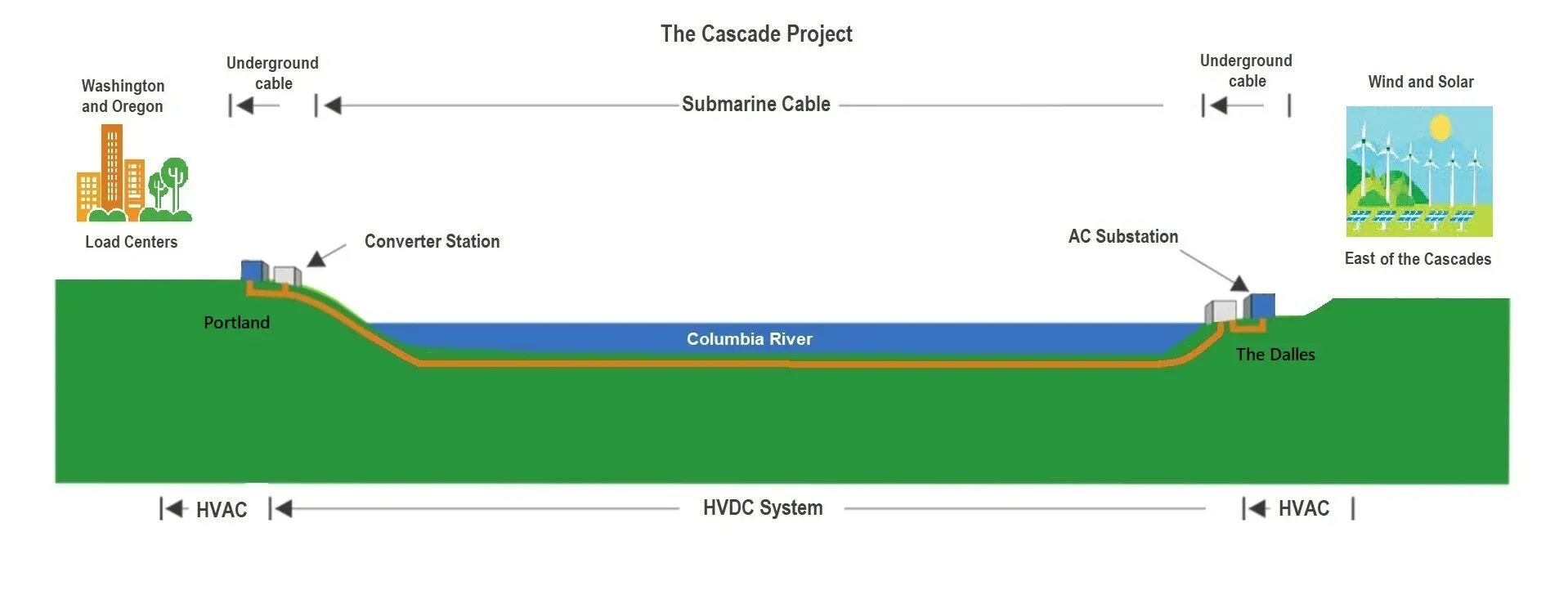
It’s essentially a pair of high-voltage DC cables buried beneath the riverbed (and underground on land at the ends), connecting converter stations near The Dalles and Portland that convert power between AC and DC. The cable itself is not a giant pipe. It’s more like a thick hose, described as around 12in wide for this project. The temporary trench or disturbed strip in the riverbed during installation is wider than the cable, and varies by method and location.
But the Columbia isn’t an empty corridor. It’s a working river, a treaty river, an ecosystem-rich river, a navigation river, and a river with layered histories, including cultural resources people are rightly protective of. There are real constraints, and they deserve serious analysis.
That’s why the controversy has an opportunity to grow beyond “for or against” and into: If this happens, what must be proven, monitored, avoided, and mitigated?
What changed
1) The U.S. Army Corps launched a formal Environmental Impact Statement (EIS) process
The U.S. Army Corps of Engineers is the lead federal agency under NEPA for an EIS for CRT. Scoping meetings were held Jan. 28-29, 2026, with a scoping comment deadline of Feb. 4, 2026.
This is a major shift: it moves CRT from “project proposal” into the start of the federal decision pipeline.
2) Washington EFSEC is also active - and it’s a different lane
Washington’s EFSEC (Energy Facility Site Evaluation Council) has been holding informational meetings and land use consistency hearings (including in Klickitat and Skamania) as part of its state siting process.
Residents are understandably confused because both lanes have hearings, deadlines, and jargon, but they’re not the same decision.
3) The controversy is now mainstream local/state coverage
Multiple outlets are now framing CRT as both a major regional infrastructure proposal and a high-stakes river project, with public attention (and public skepticism) rising quickly.
- Washington State Standard: Army Corps to look at $1.5B underwater Columbia River power line project, asks for public comment
- Columbia Insight: Are we ready for an underwater power line at the bottom of the Columbia River?
What escalated
1) Scoping testimony shows opposition is broad, and centered on the riverbed
At the Corps scoping hearing(s), testimony was overwhelmingly opposed, with repeated concerns about:
- sediment disturbance / turbidity
- contamination
- fish habitat impacts
- cultural resources and human remains
- distrust about how disputes over discoveries would be handled
2) Gorge governance questions are turning into a legal/procedural flashpoint
In EFSEC comments, some argue EFSEC must comply with the Columbia River Gorge National Scenic Area (NSA) framework and that parts of the project may conflict with NSA rules unless handled through the Gorge Commission process. This could raise thorny questions about jurisdiction and preemption.
3) Navigation and dredging conflicts are no longer a side note
A navigation-focused critique warns that cable placement could interfere with navigation channel maintenance and dredging, and pushes for more detail, including whether the route could be adjusted to reduce conflicts.
Tech reality check: what underwater HVDC is (and what risks are actually on the table)
A lot of public discourse slips into absolutes: either “no big deal” or “ecological disaster.” The research record on submarine power cables is more nuanced. Experts have tried to ensure that best practices are well-defined in industry standards and research. The big takeaways:
What tends to be real but bounded
- Installation impacts: can be temporary/localized, but the EIS should quantify duration, turbidity plumes, and recovery timelines under Gorge conditions.
- Sediment disturbance: even where ecology “recovers,” trenching/burial can disturb sediment layers; this matters more in places with contamination concerns or sensitive habitat.
- EMF and fish behavior: HVDC cables can still produce magnetic fields; some species can detect or respond to fields, which is why measurement and site-specific analysis matters.
What is often oversold by both sides
- “EMF is eliminated because it’s DC”: not exactly. HVDC changes the field characteristics, but it doesn’t make magnetic fields irrelevant.
- “The riverbed just closes up behind it so nothing matters”: some recovery can occur, but the question is what gets disturbed and where, and how that intersects with fisheries, contaminants, cultural resources, and navigation constraints.
The practical takeaway: CRT isn’t “magic safe,” and it isn’t automatically an “ecological disaster.” A practical public posture is to:
Require the EIS to prove assumptions, quantify risks, and lock in enforceable mitigation and monitoring.
Editor's note: thinking beyond "Yes or No" to this project
It’s tempting to treat CRT as optional, something we can dismiss as “unnecessary” and therefore stop by sheer force of opposition. But that binary framing often doesn’t match how our regional power system actually works. The Gorge is already one of the Northwest’s primary east-west infrastructure corridors, and the underlying challenge (moving electricity between where it’s generated and where it’s used while the grid faces new strain from electrification, extreme heat, wildfire disruptions, and aging equipment) doesn’t disappear just because a particular proposal is controversial. Even if this exact route or method changes, pressure to add transmission capacity in this corridor may return in some form. That’s why it can be strategically important to spend at least as much energy on the how, what studies must be done, what alternatives must be compared, what treaty rights and navigation needs must be protected, and what mitigation and monitoring must be enforceable, as on the if.
And so, I hope you'll take the ongoing (and in my opinion meaningful) opportunities to influence the "how," some of which are outlined below.
What’s next
1) Immediate deadline: Corps scoping comments due Feb. 4, 2026
Scoping is where you influence:
- what alternatives are evaluated,
- what resources must be studied,
- what “significance” thresholds are used,
- and what mitigation/monitoring becomes part of the enforceable plan.
2) Longer horizon: Draft EIS in winter 2026/2027, final decision winter 2027/2028
This is a years-long runway, which is why scoping matters now. It shapes what the Draft EIS will even contain.
3) Parallel lane: EFSEC continues state review and land use consistency questions
EFSEC’s process will continue alongside the federal EIS, with ongoing requests for more information (especially around land-use compliance).
How to comment right now (U.S. Army Corps EIS scoping)
Send in your comment by February 4th, 2026. Public comments don’t have to be technical, but they should ask for clear, enforceable protections. Below are examples of practical, plain-language requests regulators can actually require. You can potentially include some or all of them in your comment. Contact info for where to send your comment can be found at the end of this section.
Protect the riverbed and water quality
- Test the riverbed before work starts to identify any buried contamination along the route.
- Monitor water cloudiness (turbidity) in real time during construction and make that data public.
- Require automatic “stop-work” rules if sediment pollution spikes or contamination is stirred up.
Protect fish and habitat
- Do detailed analysis for key species like salmon and lamprey, not just general fish impacts.
- Require post-construction monitoring to make sure habitat actually recovers.
- Set clear thresholds for action; if the river doesn’t recover as expected, the company must fix it.
Respect cultural resources and treaty rights
- Require a binding “inadvertent discovery” plan so work stops immediately if cultural items or human remains are found, and Tribal protocols are followed.
- Ensure meaningful Tribal involvement in monitoring and decision-making, not just one-time consultation.
- Create a clear dispute-resolution process if Tribal governments raise concerns during or after construction.
Prevent navigation and dredging conflicts
- Coordinate formally with navigation and dredging managers so the cable won’t create hazards or interfere with maintaining the shipping channel.
- Study route adjustments that could reduce conflicts with busy navigation areas.
Make safety claims measurable and enforceable
- Require independent verification of company modeling on electromagnetic fields (EMF), heat, and realistic failure scenarios.
- Tie emergency response plans to permit conditions, not just company promises, so repair timelines and response actions are enforceable.
Why this matters:
Whether the project is approved or denied, these comments can make sure that if it is built, the river's ecosystems, Tribal treaty rights, and local livelihoods are protected through data, monitoring, and enforceable rules, not just assurances.
Deadline: Feb. 4, 2026 (received or postmarked)
Include Corps number: NWP-2022-00126-2
Submit by:
- Email: CRT_EIS@usace.army.mil
- Mail: U.S. Army Corps of Engineers, Portland District
Attn: Mr. Joe Brock - CRT Project
P.O. Box 2946
Portland, OR 97208-2946 - Voicemail: 503-808-4377 (include your name and email/mailing address)
Privacy note: Like most federal processes, comments can become part of the public record (including under FOIA). Don’t include sensitive personal info you don’t want released.
Still worth emailing EFSEC + ODOE (even if formal comment windows are closed)
Even if Washington EFSEC or Oregon ODOE/EFSC don’t have an official comment period open right now, it can still be useful to send a short “issue memo” so staff can flag your concerns as they coordinate with other agencies, request additional studies from the applicant, and prepare for future public participation steps.
Washington EFSEC (WA siting):
Email general comments anytime: comments@efsec.wa.gov
Oregon Department of Energy / EFSC (OR siting):
Contact the Facility Siting Team: energy.siting@oregon.gov
Tip: If you email, put “Cascade Renewable Transmission (CRT)” in the subject line.
Thanks as always to the Documenters for sharing their notes under CC-by-4.0. Find out more about how to become a documenter:
 bjorn.vandervoogmail.com