
🏔 Storm Recovery, Public Lands Tensions & Gorge 2030 Signals – Skamania BOCC Jan ’26
January was a dense month for Skamania County commissioners. Across three meetings, the board navigated storm recovery, federal land-management challenges, public-safety funding pressures, and early signals about the long road ahead for the Gorge Management Plan 2030 process.
🏛️ Skamania County Board of Commissioners:
❄️ JANUARY 13, 2026
Storm Impacts, Roads, and Emergency Access
The January 13 meeting focused heavily on winter storm impacts and the county’s limited capacity to respond to repeated weather events.
🚧 Road Damage & Plowing Gaps
- Public Works reported multiple landslides, downed trees, and plugged culverts.
- Crews worked extended hours to reopen key routes, including Skye Road.
- Commissioners raised ongoing concern about winter access gaps, especially along Forest Road 90 toward the north end of the county, where no agency consistently plows.
🧯 Emergency Coordination
- Commissioners discussed coordination calls with state officials regarding disaster assistance.
- The board emphasized that repeated storm response is straining road and emergency budgets and will likely remain a recurring issue.
Theme to watch: Emergency access and winter plowing on forest roads is shaping up as a 2026 policy problem, not just an operational one.
🌐 JANUARY 20, 2026
Broadband Reality Checks, Encampments & Public Lands
The January 20 meeting shifted toward longer-term infrastructure and land-use challenges.
📡 Broadband Expansion: Still Hard, Still Unclear
- Commissioners revisited why broadband remains one of Skamania’s most stubborn issues.
- New grant programs may have lower match requirements, but:
- Applications are increasingly led by private providers.
- Terrain, low density, and long-term maintenance costs continue to block county-led systems.
- Past estimates (~$60M for countywide fiber) remain a cautionary reference point.
⛺ Long-Term Encampments on Forest Lands
- Commissioners discussed growing numbers of long-term encampments near watersheds and recreation areas.
- Concerns included environmental damage, public health risks, and limited enforcement authority on federal lands.
- The board signaled interest in:
- A potential countywide encampment ordinance
- A joint workshop with the Sheriff’s Office and U.S. Forest Service
Theme to watch: Encampments on public lands are moving from anecdotal concern toward formal policy discussion.
⛺ Editor’s note: Why regulating encampments in Skamania will require a careful, compassionate eye
Skamania’s challenges in supporting its unhoused are real, and they’re shaped as much by rural housing scarcity and service gaps as by individual circumstance. Local partners (including Washington Gorge Action Programs / WAGAP) track how many neighbors are unsheltered, what barriers they face, and what kinds of prevention and stabilization actually work. WAGAP’s updates, some linked below, highlight both the scale of need and the impact of eviction-prevention and rehousing supports.
In wider regional reporting, we see that public lands often become the last safety nets to catch our neighbors when they're forced to sleep outside. Our elders and families are disproportionately among those who find themselves using this option when they're pushed out of every other option. Out of a population of around 12,400, 2.5% of our residents in Skamania are unhoused. This is an eye-popping and deeply unaccepatable number, a far higher incidence than any of our closest urban centers.
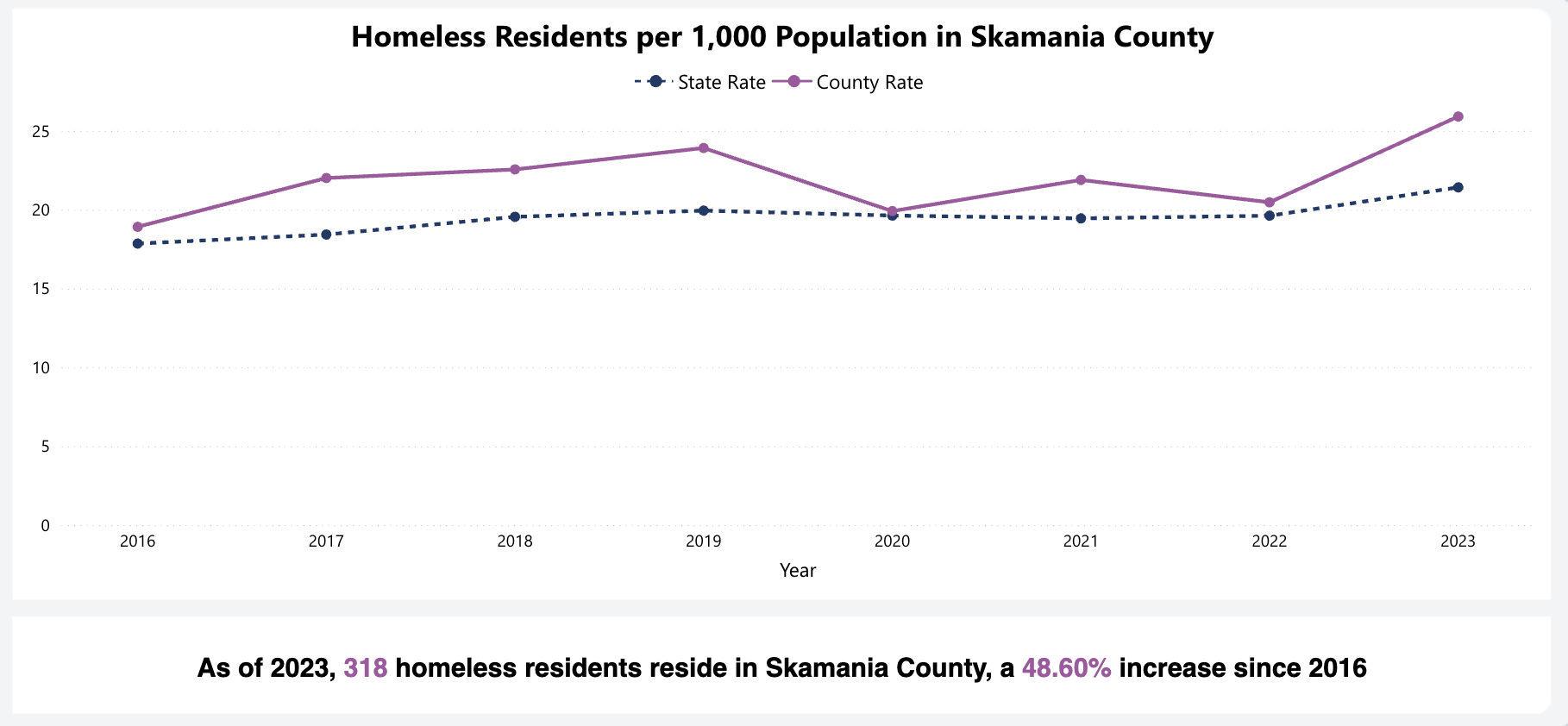
At the state level, Washington agencies repeatedly point to high rents and a shortage of affordable homes as the most significant drivers of homelessness, a dynamic that can hit rural counties especially hard when there are fewer units, fewer providers, and long distances between services. The takeaway for readers: if we want safer roads, healthier communities, and fewer people living outside, we need solutions that combine accountability with dignity: more stable housing options, listening to our local experts like WAGAP and other wraparound services, and heeding their recommendations for prevention rather than criminalization and stigma.
📌 Further reading / sources:
- WAGAP: Mid-Columbia region prepares for PIT Count (includes Skamania + Klickitat PIT household figures): https://www.wagap.org/newsfeed/mid-columbia-region-prepares-for-2026-point-in-time-count
- WAGAP: 2023 Houseless Collaborative annual report summary: https://www.wagap.org/newsfeed/2023-houseless-collaborative-report
- WA DOH dashboard explainer (uses WA Commerce “Snapshot” homelessness data by county): https://doh.wa.gov/data-and-statistical-reports/washington-tracking-network-wtn/housing-and-homelessness
- WA Dept. of Commerce housing data + reports hub (Snapshot of Homelessness, expenditures, system performance): https://www.commerce.wa.gov/housing-data/reports-and-publications/
🏔 JANUARY 27, 2026
Gorge Commission Update, Tribal Engagement & 2030 Planning
The January 27 meeting included a substantive update from the Columbia River Gorge Commission (CRGC), with implications well beyond this year.
🏞 Disaster-Related Plan Amendments
- CRGC staff reported that narrow disaster-recovery amendments to the Gorge Management Plan are nearing completion.
- Some tribal concerns were incorporated, particularly around cultural resources.
🌲 Tribal Engagement Concerns
- Commissioners raised concerns that tribes felt silenced by the expedited amendment timeline.
- CRGC acknowledged that:
- Broader issues (treaty rights, deeper cultural protections) could not be resolved through narrow amendments.
- Those issues are being deferred to the next comprehensive plan review.
Editorial note: this plan amendment has since passed.
🔭 What This Signals for Gorge 2030
- Commissioners learned that Gorge 2030 will likely be:
- Slower and more deliberate
- Built around working groups and longer consultation timelines
- Resource-intensive for both counties and the Gorge Commission
- Staffing and funding capacity will matter if Skamania wants meaningful influence in the process.
Theme to watch: Gorge 2030 is already shaping county planning conversations, well before it formally begins.
🔎 What Changed These Last Weeks
- Commissioners formally reorganized leadership and committee assignments for 2026, setting the board’s structure for the year ahead.
- Several issues that had been discussed abstractly in late 2025 like encampments, winter access gaps, and Forest Service coordination were reframed as concrete policy work items.
- The Gorge Commission update clarified that many unresolved tribal concerns are being deferred to the larger Gorge 2030 process, rather than addressed through narrow amendments.
- Routine contracts and operational decisions signaled a transition from year-end cleanup into forward-looking planning.
⚠️ What Escalated
- Concern about long-term encampments on forest lands intensified, with commissioners openly acknowledging environmental, safety, and enforcement gaps.
- Winter access and plowing responsibilities, especially around Forest Road 90 and north county communities, emerged as an urgent, unresolved interagency problem.
- Capacity constraints became more visible: commissioners discussed whether the county, the Gorge Commission, and partner agencies have sufficient staff and funding for the work ahead.
- Uncertainty around federal partners (Forest Service funding, disaster response, recreation services) continued to loom large.
🧭 What’s Next
- Commissioners expect to return soon to:
- Encampment policy options and possible ordinance development
- Forest Service coordination on plowing, enforcement, and emergency access
- Follow-up discussions tied to the Gorge 2030 planning timeline
- Committee assignments finalized these past weeks will begin shaping which issues advance fastest.
- Early 2026 meetings are likely to include workshops rather than votes, as the board scopes problems before committing to specific policy paths.
🗓 How to Attend Upcoming BOCC Meetings
📅 Tuesdays at 9:30 AM
📍 Courthouse Annex, Room 19
240 NW Vancouver Ave, Stevenson
💻 Zoom: https://us02web.zoom.us/j/88906321210
📞 Call-in: 1-253-215-8782
Meeting ID: 889 0632 1210
🗣 Public comment is taken at the beginning of each meeting.
✉️ Written comments: commissioners@co.skamania.wa.us (by noon the day before)