🍽️ Splitting the Dinner Check - a Property Tax Explainer
Your reassessment notice feels like a bill. But it's really your share of a fixed check that WA law lets grow just 1% a year. What does that mean? Here is how property taxes actually work, with real numbers, just in time for election season.
Enjoy the audio edition on Buzzsprout, or look for "Open Gorge" wherever you get your podcasts.
It's my birthday! And for this special edition of the Skamania Dispatch, I'm treating all of us to dinner. Well, an imaginary dinner that will help us unpack an often misunderstood topic that comes up ahead of election season: property taxes and what they do (or don't) pay for.
The letter comes in the spring. Your neighbor's says the county now values their place at $118,000 more than last year. They read it as a bill. They're not alone, and they're is not wrong to be worried. But the letter does not say what they think it says.
Here is the part that surprises almost everyone. Your assessment is not your tax. It is your seat at a very large group dinner.
Picture it this way: once a year, the whole county goes out to dinner together, at the same restaurant, and most people order about what they ordered last year. One neighbor gets the chili. Another gets the lamb chops. Another gets the roast chicken plate. At the end there is one big check for the table, and that check is the county's budget: the sheriff, the roads, the courthouse, the jail. Everyone chips in, and your share is set by the size of your plate, which is the assessed value of your property. A bigger plate means a bigger share of the check. That is the whole idea behind a property tax.
Now here is the rule that shapes the whole story. By law, that check can only grow one percent a year. It has worked that way, in its current form, since a one-day special session of the Legislature in November 2007. One percent. No matter how much the county grows, no matter how much the meal costs, the total on the check is only allowed to climb one percent from last year. This is the law in every Washington county, Skamania and Klickitat alike.
Once you see the table, three things follow. They explain why your bill keeps rising, why the county keeps running short, and why those two facts do not cancel out.
Your plate got bigger. The check did not.
One year, your plate is worth more. Maybe you added a baked potato with all the fixins. Maybe you changed nothing at all, and good steaks simply cost what they cost now, so the same plate you always order is judged to be worth more this year. Here is the rule of this slightly weird restaurant: a bigger plate does not add a dollar to the check. A baked potato is not a new diner. It just means you have agreed to cover a bigger share of the same check, while the neighbors whose plates were marked up less cover a little less.
Here is that idea in one picture. Imagine a tiny make-believe county of just ten homes, each paying its share of one $50,000 property-tax pie. Then three of the ten, the amber slices, are reassessed higher, by $100,000 each. Watch the wedges move while the pie stays exactly the same size.
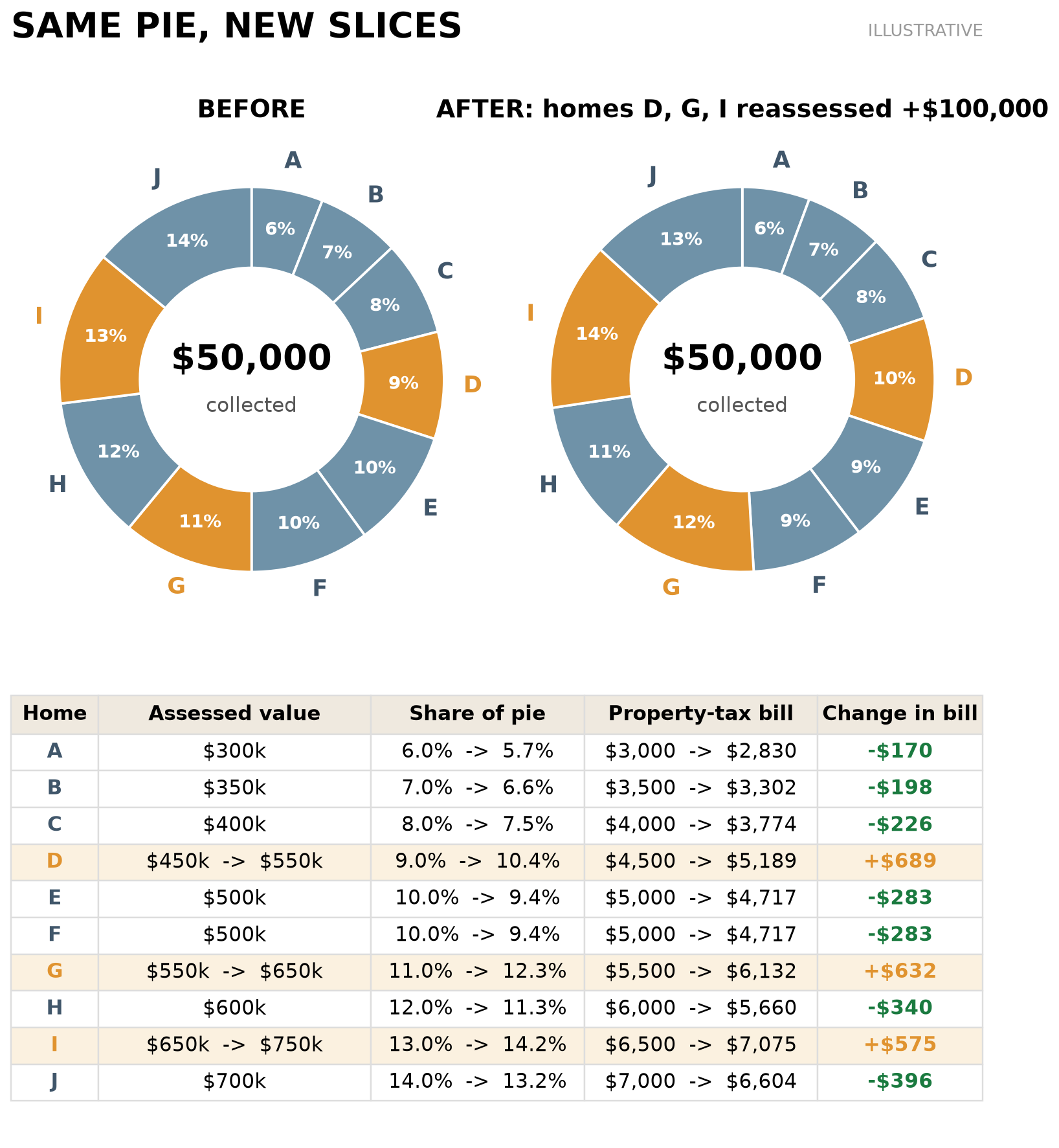
The pie does not grow. The county still collects the very same $50,000. But the three reassessed slices swell, and the other seven shrink to make room, though those seven owners' assessments never moved. The three who were reassessed pay about $1,896 more between them. The other seven pay exactly $1,896 less. Two of the seven did not change at all and still paid about $283 less each, only because their neighbors' plates grew and the shared rate ticked down, from $10.00 to $9.43 per $1,000. Nobody paid into a bigger pot. The same pot was simply re-divided. The one thing that would have grown the pie itself, a brand-new home, a new chair pulled up to the table, never sat down.
Then someone builds a house
In the make-believe county in our last example, nobody built anything, so the pie held still. So let's watch what happens when one new house does go up. Same ten homes, same $50,000 pie, plus a newly built eleventh home.
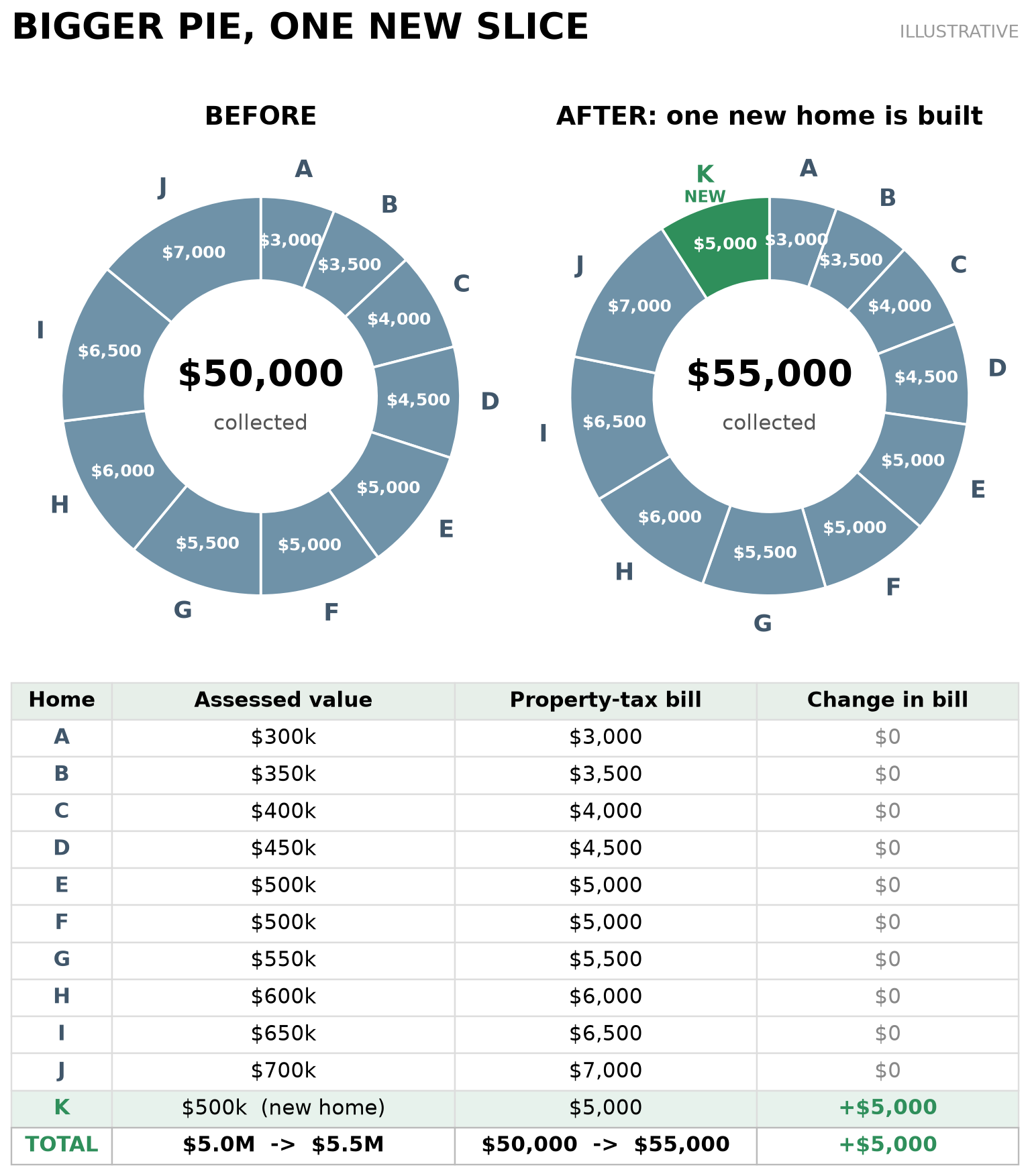
This is the one move that makes the pie itself bigger. The new house is assessed, and it pays its own share, so the county now collects $55,000 instead of $50,000. That extra $5,000 is the new house's bill. Here is the surprising part: not one of the original ten homes pays a cent more or less. Their bills are identical. The rate does not even budge. It stays at $10.00 per $1,000, because new construction enters the rolls at the existing rate, on top of the one percent limit. A new building is the only thing that sets a genuinely new plate at the table. Everything else just re-slices the plates already there.
Hold onto that. Whether the county can keep pace with its costs turns almost entirely on how many new plates it can add, and how fast.
Now, your real bill
Set the our tiny make-believe aside for a moment and go back to the everyday case, the reshuffle, this time with real numbers. We will use a Home Valley home, here in Skamania. A Klickitat home works exactly the same way, only the district names on the bill change. So take that home and look at its property-tax bill at two assessed values, side by side, using Skamania County's certified 2025 rates. On the left, the bill if the home is assessed at $400,000. In the middle, the bill after it is reassessed to $500,000. On the right, the change to each district's total check.
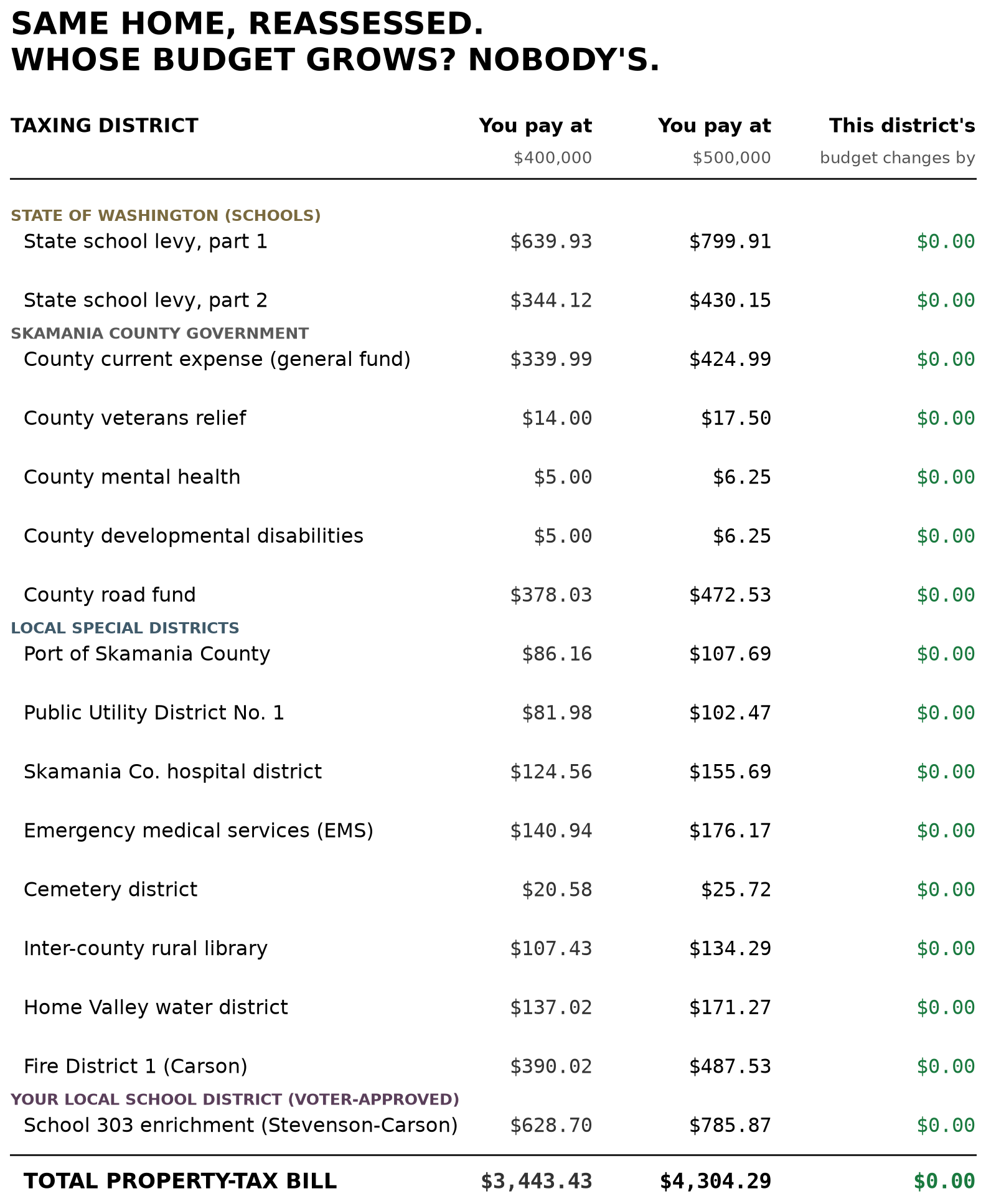
The first two columns show your bill climbing. At $400,000 the total is about $3,443. At $500,000 it is about $4,304. That is roughly $861 more, spread across sixteen taxing districts, from the state school levy down to the cemetery district.
The third column is the surprise. It is the change in each district's total check. It is zero. Every line. Not one district collects a dollar more because your plate got bigger. The county's check does not move. The fire district's check does not move. The school's check does not move. Even the state school check does not move.
Your $861 did not appear from nowhere and it did not vanish. It moved around the table. Each district's rate ticks down, by a hair, just enough to keep its check where the law fixed it. For a single home that hair is too small to see, so the table uses the certified 2025 rate for both columns. What matters is the share, not the fourth decimal. Your bigger share is offset, almost penny for penny, by everyone else's slightly smaller share. About $615 of that is local, a fixed check split among your neighbors. The other roughly $246 is the state school share, a fixed statewide check split across all of Washington, so there the diners picking up less are spread across the whole state rather than just down your road.
So the honest answer to "Why did my bill go up?" is usually not, "The county is getting more money." It's more, "Your plate grew faster than your neighbors' plates, so your slice of the same check grew."
One caveat, because the rule is not magic: a reassessment could add real money to a district only if that district were already charging the highest rate the law allows. Then its rate cannot tick down to absorb your bigger plate, and its check would ride up. No Skamania district is near that ceiling. The county charges about 85 cents per $1,000 against a legal ceiling of $1.80. So here, for now, the third column really is zeros.
And to answer a question I got while explaining this to someone else: is it possible to have your assessment go up, but your property tax bill go down? Yes! Across Skamania county alone, we found thousands of examples of properties where their assessment went up in a prior year, and their general fund contribution went down. We found more than 100 where their home value went up, and their total tax bill went down. That's the strange thing about all of this, that your home assessment in a vacuum does not determine your bill. What's going on with everyone, all our neighbors together, is the real story.
The meal keeps getting more expensive. The check still grows one percent.
If your rising bill does not mean the county is flush, how is the county actually doing? This is the second thing the table teaches, and your tax bill cannot show it to you.
The check can grow one percent a year. The meal cannot. Running a sheriff's office, a road crew, a jail, and a courthouse costs about five percent more each year, not one. That is not a Skamania failing, or a Klickitat one. Across all 39 Washington counties, median operating costs grew about 5.1 percent a year over the last decade, and about 6.3 percent since 2019. Skamania's own figure is about 6.2 percent, and Klickitat's is about 4.4 percent. Both run well past one percent. Thirty-seven of the 39 counties grew faster than three and a half percent.
We use three and a half percent in our own charts on purpose, as a deliberate floor, not a guess. Even at that gentle rate, a check that grows one percent and a meal that costs three and a half percent more open like a pair of scissors, a little wider every year. That widening gap is the county's real problem, and it has almost nothing to do with your assessment.
You can watch a county feel it every December. Each year the commissioners decide whether to even add the one percent the law allows. In Skamania, they left it on the table for 2025, about $26,605 in legally available revenue, banked for later, then took it for 2026. Up in Klickitat, the commissioners levied the maximum the law allowed all three years. Different calls, the same tiny lever.
Look at the size of that decision. The one percent a county can add is worth about $27,000 a year, right around the figure Skamania set aside. Its general-fund operating costs run about $15 million a year, and at five percent they rise by roughly $765,000. The largest move the commissioners are allowed to make on the tax side is a small fraction of the cost increase they have to cover. Your bill going up and the county falling behind its costs are both true, at the same time, and neither one is causing the other.
Everyone argues about the split. Nobody can grow the check.
Here is the quiet damage, and it is not on anyone's bill. Because the check is fixed, your tax bill is a contest over the split. If your share went up, someone else's went down. So the system turns every reassessment into a fight between neighbors: why did my plate get marked up more than theirs? People carry that question to the assessor, to the appeals board, to the kitchen table. It feels like the argument that matters.
It is not. Re-dividing the check never makes it bigger, and it never closes the gap between one percent and five. The real question is the public one: what should the meal cost, and how should we pay for it. The one percent lid quietly swaps that public question for a private grievance. It seats neighbors across from each other, arguing over slices, while the check buys less and less of the meal every year. That is the trade the structure makes, and it is worth naming plainly.
Two ways to grow the check, and why one wears everyone out
You saw the first way already, back in the make-believe county. Build one new house, and the check grew by exactly that house, while everyone else's bill held still. A new diner pulled up a chair and paid for their own meal. In tax terms that is new construction: a new house, a new building, a new warehouse, added on top of the one percent. It is the one kind of growth that happens on its own, with nobody voting on anything.
There is a second way: the people already at the table can agree to make the check bigger, by passing a levy or a bond at the ballot. But look at what that takes. The districts have to come back and ask, election after election, sometimes more than once a year, and each time the ask buys only a little more, because the starting point was held so low for so long. It is a great deal of asking for a meal that ends up only slightly better, and it wears people down. That fatigue is not a side effect. It is what a tight cap produces.
One thing is worth saying plainly, before anyone pins the county's hopes on a single big arrival. Even one large new diner is a one-time boost, not a permanent fix. It raises this year's check. It does not change how fast the check is allowed to grow, so the gap reopens and the county needs the next one.
The one percent is a choice, and it is on ballots right now
The one percent is not a law of nature. It is a number the state picked, and it has changed before. Washington voters passed the one percent lid as Initiative 747 in 2001, with about 57.6 percent of the vote. The state Supreme Court struck it down in 2007, on the narrow ground that the ballot had misled voters about what they were actually cutting. The Legislature reinstated it within weeks, without any changes to the language, despite seeing the impacts this math was already having. The court never ruled on whether one percent is the right number for every county. And that question has simply never gone back to the voters.
It is a live question elsewhere this very season. Thirty-six of the fifty states have changed their county tax-limit laws since 2019. On the same day Skamania voters go to the polls this November, North Carolina votes on writing a levy limit into its constitution, and Florida has just rewritten its own formula this summer. Whatever one thinks of caps, the country is actively reopening the question.
Now you can read your own tax bill
One piece of this is big enough to save for its own newsletter edition. The shares move around the table every year, but out here the county sits at a table where very few new chairs can ever be pulled up. A great deal of the land is already spoken for, by federal ownership in Skamania, by the National Scenic Area across both, by the terrain and the market. How that hard limit on new diners shapes everything, down to the chairs that sit permanently empty, is where this story goes in a future entry.
For now, hold onto the simplest version of it. If your bill keeps creeping up, and you cannot point to the improvement it bought, no smoother road, no newer school, no bigger hospital, and the restaurant itself looks a little more worn every year, that is not a mystery, and it is not anyone pocketing the difference. It is the check. The check was never allowed to grow much past inflation, while the price of everything it buys kept climbing. The bill on your plate went up. The meal it pays for did not.
None of this tells you how to vote. It tells you what the numbers on the page mean. When your assessment rises, split it into two questions. First: did my slice grow because my plate grew faster than my neighbors'? That is the reassessment story, a story about how the check is divided. Second: can the county actually pay for the meal? That is the lid story, a story about the gap between one percent and five. Your tax bill answers the first question. It cannot answer the second. Now you know to ask it anyway.
If you made it to the end of this long piece, I sincerely appreciate your care and your curiosity in figuring out how something that can seem as dense as tax policy could be worth turning over and reconsidering together. I really mean it when I say I believe informed communities are stronger communities. I'm so grateful to share this table every day with you as my neighbors. Thank you.
Want to help keep the Dispatch running?
The Skamania Dispatch is a community-powered public service. Every meeting summary and audio briefing is free, and always will be. If you've been finding value in this work and want to help offset the costs of document requests and software tools, you can now join as a Community Supporter for $5/month. Zero pressure to upgrade (your readership is support enough) but if you'd like to help fuel the mission, you can do so here.