
🎂 Turning 40 on a Tight Budget: Gorge Commission 6/18 - 7/14
The Gorge Commission adopted its first full rewrite of its open-government rules in decades. Plus: the one-year Burdoin rebuild scorecard, a commissioner's dissent on silence about two energy projects, and a new spider with a Sahaptin name.
🎙 A note before you read
Enjoy the audio edition on Buzzsprout, or look for "Open Gorge" wherever you get your podcasts.
🏛 Columbia River Gorge Commission: June–July 2026 Round-Up
Quick Facts
- Agencies Covered: Columbia River Gorge Commission: the full Commission (July 14) plus its Communications Committee (June 18), Executive Committee (June 30), and Economic Vitality Committee (July 1).
- The Bottom Line: After a June with no full meeting, the Commission packed its July 14 session: it adopted a top-to-bottom rewrite of its open-meetings, public-records, conflicts, and procedure rules; wrote its disaster-recovery reforms into the land-use ordinance; and took stock one year after the Burdoin fire. Underneath it all, both states have ordered flat budgets, so nearly every plan comes with "when we can afford it."
- The Vibe: Productive but pointed. The rules passed over a rare "no" vote and a protest letter, and the meeting's most memorable stretch was a respectful, unresolved argument about whether the Commission's legal caution is failing the tribes it acknowledges at every meeting.
🔎 What Changed
- The Commission adopted the first comprehensive overhaul of its administrative rules since work began in 2024 (7 to 1, with 1 abstention), and adopted the disaster-recovery rules into its land-use ordinance (8 to 0, with 1 abstention). What residents get out of both is spelled out below.
- One year after the Burdoin fire, staff report about 20 rebuild applications in motion in Klickitat County: about 10 decisions signed (6 homes, 4 farm or accessory buildings) and 4 structures now under construction.
- The Forest Service seat changed hands twice: Deputy Forest Supervisor Nicolas "Nick" Granum returned and gave the July report, and a new acting forest supervisor arrives at the end of July.
⚠ What Escalated
- Friends of the Columbia Gorge asked the Commission to postpone the rules vote, saying it got less than seven days' effective notice after the Commission's rulemaking webpage moved. The Commission voted anyway; Amy Weissfeld cast the lone no.
- Commissioner Pah-Tu Pitt challenged the Commission's silence on the Pushpum and Cascade Renewable energy projects in the meeting's frankest exchange, tying the silence to the Commission's own land acknowledgement. She also proposed studying compensation for commissioners, calling unpaid service a class barrier to who gets a voice.
- The budget vise tightened: level funding only, a required 10% cut scenario, and one narrow exception, a $175,000 IT request for the Civic Access public-records portal.
🧭 What's Next
- September 8 Commission meeting: a vote on the communications best-practices document and discussion (with possible adoption) of the committee roles memo, both deferred so commissioners could actually read them, plus the counties' first ordinances implementing the disaster amendment, a fire-season "where are we now," and 40th-anniversary planning.
- Budgets due: Oregon July 31, Washington September 15.
- The disaster rules now go to the U.S. Secretary of Agriculture for a 90-day concurrence review before they take effect.
- November: the Gorge 2030 roadmap, and the Scenic Area Act's 40th anniversary on November 17.
🏛 Full Commission Meeting (July 14)
All thirteen seats were represented except Commissioners Hochman, Litwer, and Meninick; Chair Carina Miller presided over a three-hour Zoom session.
⚖️ The Commission rewrote its own rulebook
- Two votes adopted two packages: the administrative rules (Divisions 11, 12, 14, and 16: open meetings, public records, conflicts of interest, administrative procedure) passed 7 to 1 with 1 abstention; the disaster-response rules (Division 82) passed 8 to 0 with 1 abstention. Chair Miller abstained on both.
- The rules must track "the more restrictive" of Oregon and Washington law under the National Scenic Area Act, which counsel interprets as whichever state's law produces more transparency.
- Friends of the Columbia Gorge requested a continuance, saying it effectively got less than seven days' notice. The Commission declined.
This vote ended a project that began in 2024, ran through six Rules Committee meetings and both states' attorneys general, and produced something the agency has never had: a 47-page public report explaining where every rule came from. The Commission is a strange legal creature. Neither state's open-government laws apply to it directly (two courts confirmed that in 2023); instead, the Act requires it to blend the stricter parts of both states' laws into rules of its own. "Of all the 260-some compact agencies that exist out there, and I've studied them all," Litwak told commissioners, "we are the only one who has to deal with this problem."
What residents actually get is worth spelling out. Under the adopted text, the Commission must respond to a records request within five business days, may not charge for search time (only for copies), must post agendas at least 24 hours before meetings, must keep meeting recordings online at least six months, must set aside public-comment time at every regular meeting, and must let news media attend executive sessions, an Oregon-derived right Washington law does not grant. The old enforcement rule, with its $100 personal penalty on commissioners, was repealed; enforcement now runs exclusively through the National Scenic Area Act's court-review process.
The notice fight gave the hearing its drama. Friends' staff attorney Steve McCoy wrote in the group's comment letter that it received the hearing notice by email on July 7 at 2:06 p.m., under seven days before the hearing, because the Commission's rulemaking webpage had moved and Friends "was not tracking the new page." Litwak's rebuttal was a chronology: filed in Oregon in April after the Commission voted in March to launch the rulemaking, published in the May 1 Oregon Bulletin, the Washington text out June 17, on the Commission's website since May 26, and drafted in public since 2024. "If you want to delay adopting these, you can," he said, "but don't do so because you think there's improper notice." Commissioner Nichols was blunter: "if some people don't notice in time, that's on them." Weissfeld saw it differently, asking what harm a two-month wait would do: "the reason to wait would be simply that there is a request to do so and no reason not to... it's really part of just being responsive to our partners and stakeholders in the National Scenic Area." Hers was the lone no. Wasco County's comment letter pressed a different point, that "cohesiveness" is not an exception the Act allows when choosing the less transparent state's rule, and urged a standing schedule for re-checking the rules as state laws change.
The practical fix: after Friends' written request, its attorney is now on the Commission's individual-notice list, which anyone can join by emailing their request to info@gorgecommission.org.
🔥 The disaster rules are now law (pending one signature), and a one-year scorecard
- Division 82 writes the January disaster-recovery Plan Amendment into the Commission's own land-use ordinance: the rebuilt-home size ladder (a destroyed home of 1,250 square feet or less may be rebuilt up to 20% larger, scaling to a 3,000-square-foot cap), the extended timelines, expedited review for in-kind replacement, and the temporary RV and storage-structure allowance.
- The temporary-use process requires no application at all: a landowner asks, staff draws the site plan, and the Executive Director "shall issue a letter and site plan" approving it. Friends asked to soften "shall" to "may"; the Commission kept "shall" on purpose.
- The rules take effect after the U.S. Secretary of Agriculture's 90-day concurrence review (the Secretary already concurred with the underlying plan amendment on February 24).
- One year after Burdoin: roughly 20 applications, about 10 signed decisions (6 single-family homes, 4 agricultural or accessory buildings), 4 structures under construction, and about half of everything moving through the faster like-for-like track.
The "shall" debate was small but revealing. McCoy argued the mandatory word could force approvals; Litwak answered that it exists to bind the agency to help: "if we're going to tell somebody that they can put an RV or a temporary structure on their property, then shall is the correct word... We just simply won't send them a letter and their approved site plan if we're not going to approve it." Commissioners sided with staff, 8 to 0.
About half the replacement homes are mobile or manufactured, some chosen by families who previously had stick-built houses, "because it's just more affordable these days," staff said. The Klickitat office charges no permit fees, and planners described sitting with applicants who have no email, filling out forms with them and drawing their site plans. From the front desk, staff said some applicants "have been in our office so much that we feel like they're almost part of our family," including one woman who bought a ladder and climbed into her unfinished house before the occupancy permit arrived; Commissioner Fowler credited Connie Acker by name for that sense of welcome. Commissioner Brennan Bissell, who said she became a commissioner after her own bruising early experience with the agency ("they pretty much told me I need to figure it out myself"), pressed the equity question anyway: who is tracking whether people without paperwork fluency, or English, or a high-school diploma are making it through? She thanked staff "for the culture shift." Fowler, whose own home was threatened in the Burdoin fire, confirmed the neighbors she hears from are warming to an agency they once viewed coldly.
The fire theme ran all morning. A June 16 defensible-space tour put county planners, wildfire practitioners, and Commission and Forest Service staff on the same properties for the first time, about 21 people at three homes. The takeaway, per the fire professionals on the tour: wind-blown embers, not trees, are the leading cause of home loss in the Gorge, and the five feet hugging your foundation matter most. Fowler shared that firefighters defending her home cut down a screening tree the rules had once required her to plant. Whether defensible-space standards should extend beyond forest-zone properties is now an open Gorge 2030 question.
🗣 "I don't feel like we're doing our duty": the silence debate returns
- The Communications Committee reported its recommendation against public statements on the Pushpum energy storage and Cascade Renewable transmission projects (litigation and appeal-jurisdiction risk).
- Commissioner Pitt dissented on the record, tying the silence to the Commission's own land acknowledgement, and proposed studying commissioner compensation as an equity measure.
- Commissioner Brennan Bissell backed both points and asked whether any rule addresses commissioners or staff disparaging each other in the press.
This was the exchange the meeting will be remembered for. Pitt argued the Commission is "way behind being able to make a difference in the process": "if we can't echo, especially in a timely manner, I don't feel like we're doing our duty that we set forth in the land acknowledgement." She added a structural point: unpaid committee service filters out people who cannot leverage a flexible job, "and so then we're eliminating the voices, and saying we're doing equity." Brennan Bissell agreed "so strongly," saying some commissioners "are not supported economically in the same way that other people are." Nichols pushed back on precedent grounds: comment once on an outside project and you invite demands to comment on everything, and prejudging the transmission line risks the Commission's own appellate role. Weissfeld held the middle, calling the distinction "nuance that perhaps may have been missed": projects that may come before the Commission are different from projects that never will. Chair Miller, a Warm Springs member, closed it with visible care: "for me as a tribal person," the navigation is "really hard," and while she understands the legal constraint, "I just encourage us to continue trying to push." No motion was made; the question is not going away.
Brennan Bissell's other question, whether there are "any repercussions" when the executive director or commissioners "slander" other commissioners in the press, referencing coverage she says harmed her, got a candid answer from Johnson: the best-practices document is "carrots and not sticks," guidance without penalties. The document goes to a September vote, and the committee roles memo to September discussion, so commissioners have more than a week to read them. We will post this draft when it becomes available.
Disclosure: during the Executive Director's report, Commissioner Fowler praised a public comment on accessory dwelling units "from Kate Bertash," saying she'd "done a spectacular job of setting the stage of where we are in the Gorge right now." That comment, a regional ADU policy brief, was submitted by the author of this newsletter, who covers these meetings for the Dispatch and maintains the Open Gorge Public Meetings Archive. It is independent analysis, speaks for no government, and you can read it in the meeting record. A second ADU comment, from Lyle resident Jerrold Richards, asked plainly when ADUs might become legal on his six acres; staff's written answer confirms ADUs are currently not permittable anywhere in the Scenic Area, one of the two big topics queued for the Gorge 2030 plan review.
🌲 Forest Service report: new faces, quiet wins, and an arson question
- Nicolas "Nick" Granum is back as Deputy Forest Supervisor after a stint at the Gifford Pinchot; an acting forest supervisor, Maren Palmer (name per the meeting audio; she is not yet on the agency's public roster), arrives at the end of July; thanks went to Casey Gatz for holding the seat.
- Campfire restrictions are in effect on forest lands, and extra firefighting resources are staged in the Gorge under severity funding.
- On the federal wildland-fire consolidation: Interior's share (about 20% of the national force) has consolidated; the Forest Service's 80% has not, pending a congressional review, with no changes this fire season.
Granum's grab-bag was the pleasant kind of news: the Eagle Creek trailhead registration hut is nearly restored, the Dog Mountain trailhead bathroom finally has a new roof, eastside forest-health work is breaking ground on the Oregon side with Washington's out for comment, and a fisher, a rare forest carnivore, was spotted in the Scenic Area. The sharper moment came from Brennan Bissell, who asked directly whether arson is being investigated, calling the Lyle fire's timing "potentially suspect" and noting reported clusters. Fowler said she thought Columbia Gorge News had reported Hood River police looking into an arsonist for smaller fires. Granum said he believed the Lyle fire hadn't burned forest-system lands, which would put the investigation with local agencies, but promised to ask. The Lyle fire itself, which threatened Fowler's "poor town," was ultimately mapped at roughly 233 acres after an initial estimate near 1,500.
🕯 A farewell, a correction, and a spider
The Commission unanimously adopted a resolution of appreciation for Barbara Bailey, an early member of the bi-state Commission (the resolution puts her service at 1987 to 1995), whose family runs Orchard View Farms near The Dalles and whose farming perspective, the resolution notes, shaped the plan's agricultural provisions. She died May 10. The adoption came with a live fact-check: the draft named her appointer as "Washington Governor Neil Goldschmidt," and Commissioner Reynolds gently pointed out Goldschmidt was Oregon's governor. The resolution was corrected on the spot. (Her published obituary complicates the record one step further, crediting Governor Barbara Roberts, who took office in 1991, with the appointment. Even memorials benefit from fact-checkers.) Her daughter Bridget later served on the Commission as well.
The meeting also delivered the year's best Treaty Tribe Word of the Day: Jeremy FiveCrows of the Columbia River Inter-Tribal Fish Commission introduced the Sahaptin name given to a newly discovered cave spider from the Herman Creek watershed, only the second species of its genus ever found. Yakama Nation elder Anthony Washines named it tulishpun. FiveCrows walked through the word on the tape: cave, from, predator, a cave-dwelling predator, which is also exactly what its Latin genus name, Trogloraptor, means. The species is now formally Trogloraptor tulishpun, and the tribes held a naming ceremony at the trailhead, drumming and giveaway included. As FiveCrows put it, "part of a living language is its ability to incorporate new words."
📋 Also at the meeting
- The revised, full-color "Building in the National Scenic Area" handbook is done and headed to county planning offices, the web, and, at Fowler's suggestion, the region's realtor associations, so buyers learn the rules before they buy. We will share this when it becomes available.
- Storedahl Quarry: the Commission keeps getting copied on comments about the quarry's draft environmental impact statement, and staff are redirecting them; the site is in Skamania County, outside the Scenic Area. One typed comment asked a harder question the meeting didn't answer: Stevenson's Mary Repar urged the Commission to file its own agency comment, since the project would put 500 daily truck trips on Highway 14 through the Scenic Area. Comments run through July 30; our June county round-up has the full story.
- Records requests: after counsel's spring plea for cooperation with a "barrage" of requests, staff reported the agency has now answered "virtually every one," with a couple of large ones still in progress within their stated timelines.
- Oregon's budget goes in July 31 (level funding, plus the $175,000 Civic Access IT request, which Oregon's technology office has cleared for submission); Washington's follows September 15, with its own $175,000 match request now in front of WaTech.
🗣 Communications Committee (June 18)
Chair Amy Weissfeld was out following a death in her family, so Commissioner Alex Johnson ran the meeting. No votes of consequence were taken; the committee reviewed drafts and set direction.
📣 Telling the Commission's story
- The committee reviewed Version 2 of a "Communications Best Practices" guidance document, which now opens with a new proactive section, "Telling Our Story," on top of the earlier reactive, media-inquiry material.
- Because Chair Weissfeld was absent, the committee did not move the document out of committee. (The vote is now set for September 8.)
- The committee also sorted the Avarna Group's communications recommendations, agreeing to pursue the volunteer-friendly ones now and to shelve the items that require paid staff.
This is the next beat in a story the dossier has tracked since the Avarna Group's 2025 governance review, which followed public friction over a former commissioner's resignation. The committee's conclusion was that it agrees with most of what the consultant recommended, including a public-education campaign and a "commissioner storytelling series," but that the pieces needing real money (a contract communications strategist, professionally produced videos) are not realistic while the agency is, in Johnson's word, "skinny." One recommendation drew particular attention, a suggestion that the Commission more clearly distinguish itself from the advocacy nonprofit Friends of the Gorge (a relationship that has flared into open conflict this year) and better explain what the agency does and does not regulate, especially on economic development and land use. The Dispatch tracked the launch of this "tell our own story" effort back in March.
⚖️ Two energy projects the Commission won't discuss
This is where the July 14 silence debate began. A commissioner had asked the Commission to consider a formal statement, understood to be against the Pushpum energy storage facility; staff advised against taking any position on either Pushpum or the Cascade Renewable transmission project. Executive Director Wolniakowski laid out the legal logic: Pushpum is in litigation, "so we can't really be commenting on it or taking a position on it," and the Cascade line, a power cable buried mostly in the Columbia riverbed, crosses the Scenic Area, so "it might come back to the Gorge Commission for an appeal." Staff offered an informational one-pager instead. The full argument over that caution, and the dissent it drew, is in the July 14 section above.
🏛 Getting ready for a level-funded budget fight
- Both states have instructed the Commission to submit current-service-level budgets ("Carry Forward" in Washington), with no new funding packages.
- The plan for fall: legislative outreach for the 2027–2029 session, built on plain-language one-pagers and in-person contact rather than short Zoom calls.
- Commissioner Lach Litwer floated a "getting to know the bi-state agreement" tour, physically bringing legislators into the Gorge.
This is the sharpest turn in a budget arc the Dispatch has followed for months, from a cut that pushed the Commission to bimonthly meetings and a four-day staff week, through supplemental requests to restore positions, and now to a flat ceiling that holds the agency at what one committee member put at "70, 71%" of its funding from a couple of years ago. Johnson summarized the posture bluntly: "it's a defense strategy. It's not an offense strategy where we're trying to grow things and do new things." Litwer argued that 15-minute Zoom calls cannot convey why the place matters, and pitched hosting legislators in person: "We could send a bus to get them. Heck, I've got a line on a bus here." Wolniakowski noted precedent, including a 2018 legislative tour by minibus and the now-dormant "One Gorge" receptions in Salem and Olympia, and said she had already talked with state Representative Kevin Waters about organizing something for late summer or early fall.
The conversation also turned to tourism as an underused argument: one commissioner pointed out that tourism generates an estimated $14 billion in Oregon and funds a roughly $45 million Travel Oregon budget through lodging taxes, and suggested the Commission build a direct line to the state tourism office. As one commissioner put it, "jobs is not a four-letter word."
🧭 Executive Committee (June 30)
With Chair Johnson presiding and meeting coordinator Connie Acker out sick, the committee set the July 14 table (you just read how that played out) and handled some structural housekeeping. It approved the committee roles-and-responsibilities memo, the first refresh in about ten years, which puts on paper that committees make recommendations rather than decisions, exactly the clearer-governance line the Avarna Group called for. Johnson described the point as making sure structure matches practice: "recommendations come in, recommendations go out," and the committees are explicitly "advisory. They're not for making commission decisions." Commissioner Rodger Nichols volunteered for the Economic Vitality Committee, and new Multnomah County commissioner Abby Hall is onboarding, with interest in Communications.
🌲 Gorge 2030: planning how to plan
- Staff are building the roadmap for the next full Management Plan review, branded "Gorge 2030" (a name staff say is not final).
- A roadmap presentation to the full Commission is planned for November, with commissioner orientation sessions in spring 2027 and the working phase starting in the 2027–2029 biennium.
The biggest long-range item on the agency's plate. Staff are mining the last overhaul, the 2020 review, to decide what worked and what to streamline; that round stretched long for reasons staff can now name (a six-person staff, the Eagle Creek fire, three federal furloughs), and this time they believe two years is realistic. The known deep-dive topics are already named: ADUs and the agricultural income test. Staff capacity will not grow, so the review has to be leaner. Wolniakowski has even floated aiming the vision further out, "Gorge 2050," and by July 14 staff had begun one-on-one listening sessions with each county planning department. Expect the public phase to open in 2027.
🎂 40th anniversary of the Scenic Area Act
- November 17, 2026 marks 40 years since the National Scenic Area Act became law.
- Ideas floated: a "40 fun facts" countdown on social media, an in-person November meeting with a low-cost celebration attached, and broad invitations to tribes, counties, communities, and former commissioners and staff.
Budget shaped this conversation too: a full public celebration probably is not affordable, so the working idea is to "piggyback" a modest gathering onto an in-person meeting. Commissioner Nichols, a newspaperman who can place stories in the Columbia Gorge News and the Goldendale Sentinel, urged inviting the tribes and Friends of the Gorge, adding that Friends "have a lot of money, maybe they could help us sponsor this." Gatz tied the anniversary to the agency's core story, that "the success of the National Scenic Area is really grounded in the partnership of all of us coming together." The last major marker, 25 years ago, was held at Skamania Lodge.
🔥 Fire season, one year later
The committee put a one-year check-in on the disaster-recovery Plan Amendment on the September 8 agenda and set up a recurring Forest Service "fire season in review" briefing for each January. The Commission began that emergency amendment last September and passed it in January; the July 14 rebuild scorecard above is the first installment of the answer, and September asks the communities themselves. Commissioner Nathan Reynolds cautioned that early September is poor timing for a true retrospective: "I don't know that it would be as much of a look back in the first week of September as a where are we now. I think the first week of September is still the height of the fire season." Gatz agreed a fuller Forest Service review fits better in January.
🌾 Economic Vitality Committee (July 1)
Chaired by Commissioner Litwer, with Commissioner Steve Hochman present and Vice-Chair Jerry Meninick joining partway through, the committee finally had a quorum after earlier misses. (It last convened to hear Skamania County's economic case in March.) Commissioner Laura Brennan Bissell was absent for a family matter.
💵 The $10 million loan program, and a call to measure it
- The committee walked the Avarna Group's economic recommendations one by one, marking most as already underway or better suited to the Communications Committee.
- On a recommendation to "audit" how the Commission has supported economic development (for example, the roughly $10 million business loan program run through the state investment boards), the committee softened "audit" to "review."
- Chair Litwer pushed for a shared policy rubric with the funding partners, agreed in advance, to measure whether the money achieves its goals.
A quick map: the Oregon Investment Board's funds flow through the Mid-Columbia Economic Development District (MCEDD), and the Washington Investment Board's funds flow through the Skamania County Economic Development Council. The Commission's role is narrower than many assume; it certifies that projects are consistent with the Scenic Area Act, while the boards set loan policy. Litwer's argument was that certification is not the same as accountability. He wants the five partners to agree up front on "what do we understand our shared policy objectives for this money to be," and then to come back later and ask "whether doing those things, A, were done, and B, had the effect that they were intended to have." Staff and MCEDD Executive Director Jessica Metta noted this dovetails with the Economic Vitality Plan update and the Commission's Vital Signs Indicators work. Vice-Chair Meninick, of the Yakama Nation, cut to the governance question underneath it all, saying he needs to sit down with the Executive Director to understand the Commission's real role, because "it always seems that it's the commission that ends up having to justify the actions of others."
🚜 The $80,000 farm-income test
- The test requires a working farm to show gross farm income before an owner may build a house on land in the Scenic Area's larger-scale agriculture designations (smaller "Small-Scale Agriculture" parcels are exempt). Staff noted this is gross sales, not profit, which "most of the time" nets out to zero after expenses.
- The threshold rose from $40,000 (2004 Management Plan) to $80,000 (2020 revision), a CPI adjustment that also matched Oregon's statewide farm-dwelling standard. Washington has no equivalent rule; the Commission applies the test on both sides of the river.
- In her 11 years, Executive Director Wolniakowski said, Klickitat County has never formally processed a project under the test, and the 2020 doubling "created a lot of anxiety."
- Open questions the committee raised: whether one threshold should apply equally to a 20-acre parcel and a 160-acre ranch, what alternatives exist, and that the farmers most affected were invited to July 1 but could not attend. A fuller presentation from Commissioner Laura Brennan Bissell was postponed.
Wolniakowski presented the test as protecting farmland affordability rather than targeting farmers. Her argument: building a house on farmland can "triple or quadruple" its value, which prices out the next person who wants to buy it to farm, so the income requirement keeps working land within reach of working farmers. She pointed to the rule's footprint on the ground, that in 11 years Klickitat County has never formally processed an application under it, because "once people find out about that income test, then they just don't either buy the property or they decide not to" build. (The Dispatch broke down how the test works, and who it can shut out, in April.)
That same fact carries a second reading, and the committee did not avoid it. A rule that stops projects before they are ever filed also means the people it turns away leave no paper trail, and no one has studied who they are. The bar is $80,000 in gross sales, and it applies the same to a 20-acre place as to a 160-acre ranch, so its weight falls hardest on smaller operations and on owners who cannot show that income before putting a home on land they already own. Chair Litwer named the bind directly, describing "two very valid policy objectives," one "supporting the ability of folks who work in the land to live on the land that they're working," the other keeping desirable land from becoming rural estates for people not farming it at all. He added that he had never "seen an elegant solution that's really managed to achieve that goal without having adverse unintended consequences."
The committee's honest position is that it lacks the evidence to settle this. Staff want the coming agricultural analysis to show how much designated farmland is actually in production, and whether a single threshold makes sense across very different parcel sizes. And the group with the most at stake has not been heard: farmers were invited to July 1 but were unavailable. Longtime public commenter Lynn Burditt, who worked on past Gorge reports from the Forest Service side, urged reading the entire agriculture section of the plan rather than judging the test in isolation, recalling that it grew partly from an effort to keep large parcels from becoming estates, and that the Forest Service has litigated over farmland use before.
📊 The Five-Year Report versus the CEDS clock
- The Economic Vitality Five-Year Report is due to both legislatures by the end of 2026.
- MCEDD's separate regional strategy, its five-year CEDS (Comprehensive Economic Development Strategy) update, is not due until about March 2027, creating a data-timing mismatch.
- The committee wants to ask the states whether the two can be synced.
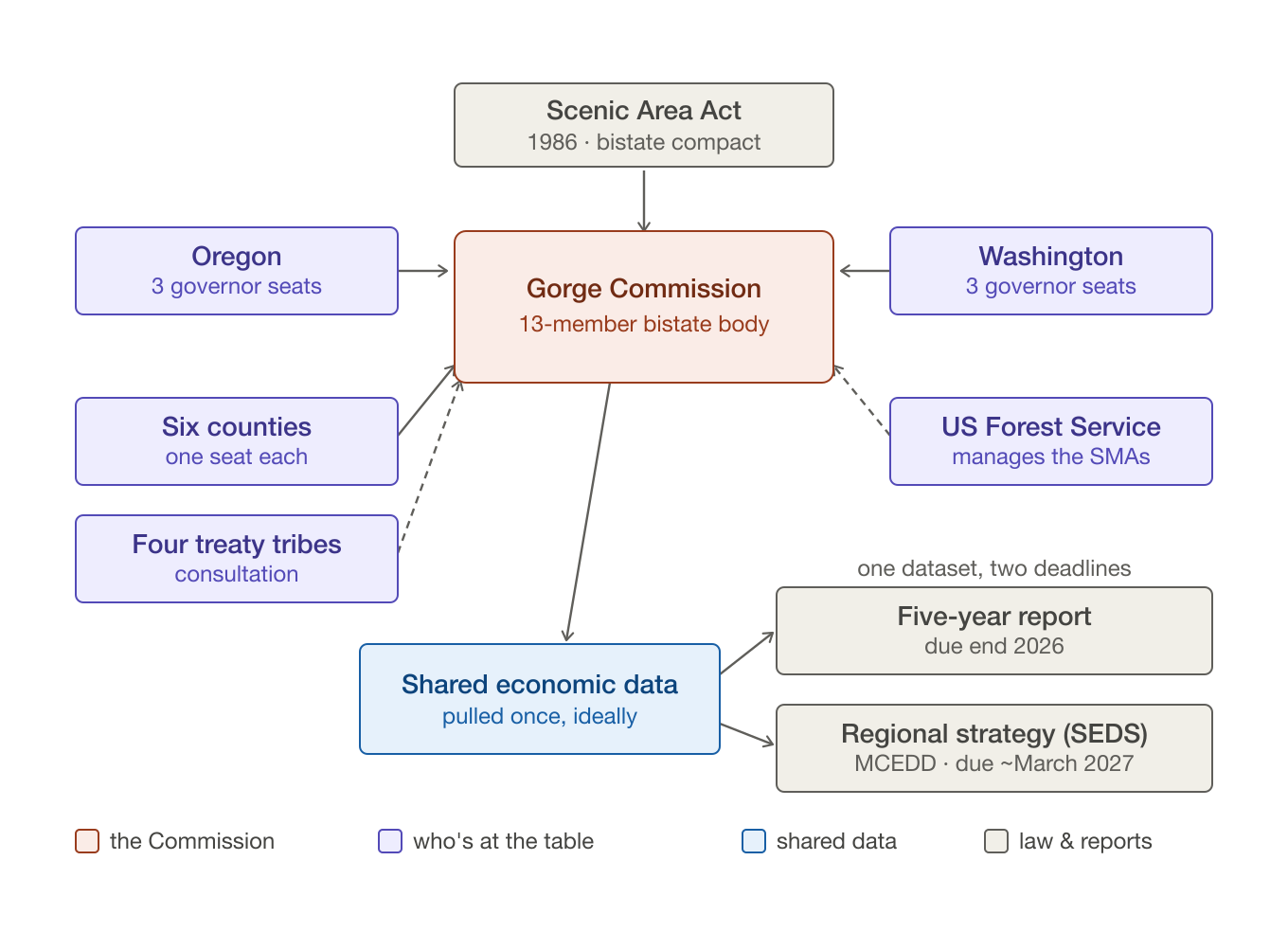
Both documents rest on the same underlying economic data, and MCEDD Executive Director Jessica Metta was blunt that pulling that data twice, months apart, is wasteful. Asked whether the Commission could simply align the deadlines, she offered the line of the meeting: "Who would notice if we were late? I don't know. It's my question." Burditt, who has helped scrub past reports, suggested framing a formal request to Business Oregon and Washington Commerce (the state agencies that oversee this reporting under the Act) rather than assuming a hard deadline. As a practical hedge, Metta floated a short two-page economic-vitality summary that Wolniakowski wants in hand for March budget testimony regardless of the plan's timing, so legislators have something concrete. Beneath the scheduling sits the month's recurring theme: the Commission struggles to explain its economic role. Burditt captured it from the public's seat, noting that after nearly two decades connected to the Scenic Area, "as I'm listening to you, I can get confused," and suggesting a simple visual, almost a cartoon, mapping how the Commission, six counties, two states, tribes, and the funding boards fit together. Litwer's reply drew a laugh and a real idea: "I think I hear a call for a schoolhouse rock of the scenic area."
We took a crack at this visual of how the Commission is organized, let us know what you think:
⚠️ Editor's Note: Broader Context
- "Level funding" is not the same as "stable." Holding a budget flat while costs rise is a real-terms cut. The Commission already runs at roughly 70 to 75% of its funding from a few years ago, with staff below full-time, so a flat 2027–2029 budget locks in that reduced capacity even as the workload grows.
- The notice dispute is really a webpage dispute. The Commission met its legal minimums; Friends' complaint is that the rulemaking page moved and watchers weren't told. The fix, an individual-notice list, is one any resident can join by contacting info@gorgecommission.org.
- The Commission's "no comment" on energy projects is structural. As a quasi-judicial body that may hear appeals, the Commission avoids public positions on matters that could come before it. That is the same reason a judge does not comment on a pending case. The live question, raised from within, is whether acknowledging tribal opposition without taking a side crosses that line.
- Committees advise; the Commission decides. The roles memo now in front of the Commission formalizes a line that matters for the public: a committee's "recommendation" is not an agency action until the full Commission acts on it.
- "Concurrence" is the last gate. Because the Forest Service co-manages the Scenic Area, the disaster rules the Commission adopted cannot take effect until the U.S. Secretary of Agriculture agrees they are consistent with the federal side of the plan, a review capped at 90 days.
🛠 Jargon Buster
- Division (as in "Division 82"): a chapter of the Commission's own rulebook. Divisions 11, 12, 14, and 16 are its open-government rules; Division 82 is its land-use ordinance's disaster provisions.
- Ag Income Test: a rule requiring proof of farm income before a house can be built on larger-scale farmland, meant to keep working farmland affordable for farming.
- Economic Vitality Plan / CEDS: two economic strategy documents. The first is the Commission's bi-state report to the legislatures; the CEDS (Comprehensive Economic Development Strategy) is MCEDD's broader regional development strategy.
- EFSEC: Washington's Energy Facility Site Evaluation Council, the state body that coordinates permitting for large energy projects.
- Concurrence: the U.S. Secretary of Agriculture's sign-off, required before Commission plan changes touching Forest Service-managed lands take effect.
📌 How to Join and Learn More
- Next full Commission meeting: September 8, 2026, by Zoom. Agendas and registration links are posted at gorgecommission.org. Written comments go to PublicComment@gorgecommission.org by noon the day before the meeting.
- Committees (Communications, Executive, Economic Vitality) meet monthly, also by Zoom, and are open to the public, with time for comment.
- Want notice of every proposed rule? After the Friends dispute, the Commission maintains an individual-notice list for rulemaking filings; ask via info@gorgecommission.org.
🔗 Related Dispatch coverage
- Gorge Commission Debates "Cheater ADUs" & Looks Ahead on Tribal Consultation. Our December deep dive into the Rules Committee drafts that became the package adopted July 14.
- A Craving for "Snickers": the Gorge Commission's May committee round-up. The previous installment in this series.
- Gorge Commission Passes Disaster Recovery Amendment: What Changed, What Didn't, and What Comes Next. The January action that just became enforceable rule text.
- Is the "Ag Income Test" Protecting Land or Blocking Farm Housing?. Our April explainer on the farmland rule above.
- Special Report: Cascade Renewable Transmission, an Underwater Power Line with a Long Road Ahead. The project the Commission won't comment on.
Want to help keep the Dispatch running?
The Skamania Dispatch is a community-powered public service. Every meeting summary and audio briefing is free, and always will be. If you've been finding value in this work and want to help offset the costs of document requests and software tools, you can now join as a Community Supporter for $5/month. Zero pressure to upgrade (your readership is support enough) but if you'd like to help fuel the mission, you can do so here.